



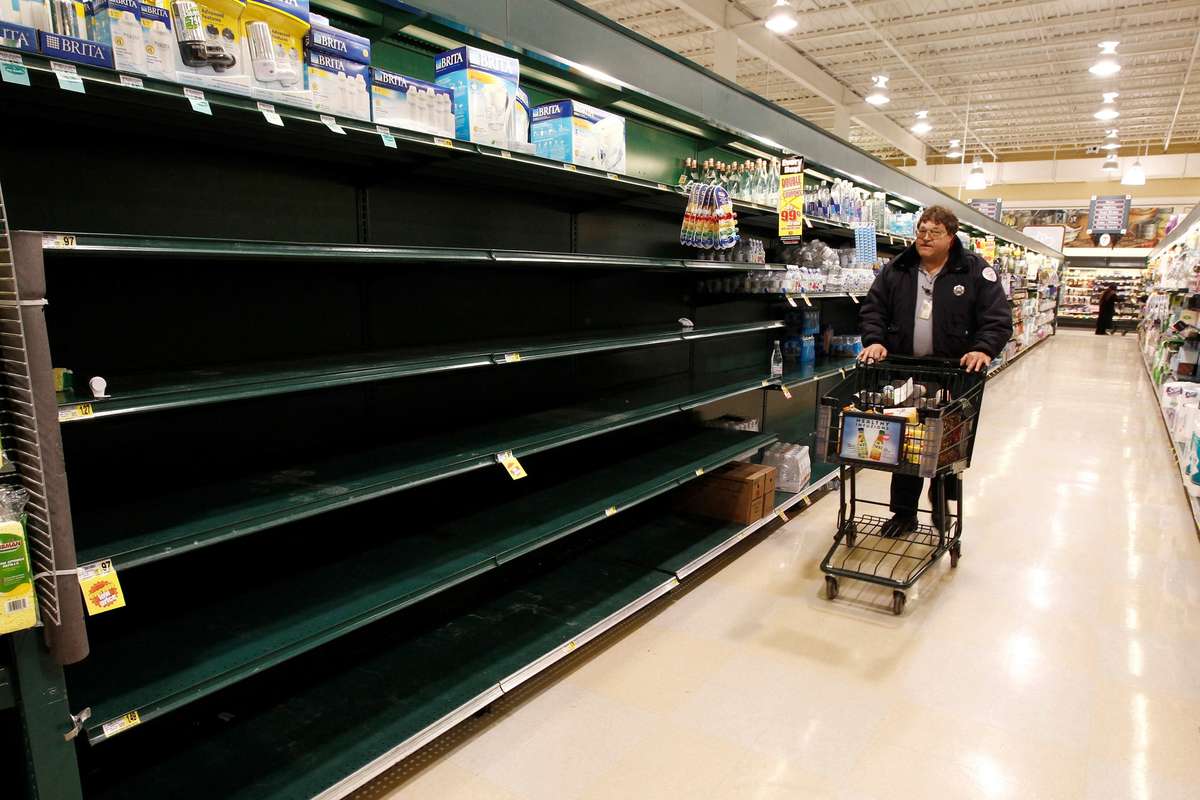

The British government should be stockpiling food as it is not prepared for climate shocks or wars that could cause the population to starve, states a leading expert on food policy.
Prof Tim Lang of City St George’s, University of London said the UK produced far less food than it needed to feed itself, and as a small island that relied on a few large companies to feed its giant population, it was particularly vulnerable to shocks.
“We’re not thinking about this adequately. We’re ducking it,” Lang said, speaking at the National Farmers’ Union conference in Birmingham.
“The default position that others can feed us is hardwired into the British state system, and indeed into the nature of how agrifood capitalism works in Britain. Others are wiser. Other countries are stockpiling,” he said.
“Other countries have much more flexibility in their systems than we do. What we glorify as efficiency is now vulnerability.”
The first UK Food Security Report in December 2021 found the country was 54 per cent food self-sufficient. Other rich countries such as the US, France and Australia are all food self-sufficient, meaning they grow enough food to feed their populations without imports if required.
The UK is one of the least food self-sufficient countries in Europe. The Netherlands, for example, which is densely populated, is at 80%, and Spain is at 75%.
Lang’s report for the National Preparedness Commission, published last year, found that the UK’s food system is extremely vulnerable to attack due to its concentration with a few large companies.
It found that the 12,284 supermarkets around the UK are “fed” by just 131 distribution centres.
These were a “sitting duck” for drone or cyber-attacks by malign states, he said: “The nine big retailers account for 94.5% of all retail food. That’s nine companies, using just 131 distribution centres. In drone war, that’s a sitting duck.”
Brexit has also made the UK more vulnerable to shocks, by reducing the subsidies farmers receive to produce food and making it more difficult to import food from our largest trading partner.
Lang's report also touched upon UK's vulnerability on the face of global climate crisis.
“Climate change, the floods and droughts, these are part of vulnerabilities to the just-in-time logistics system of the food system.
"The key finding of my report was that we created a food system in the name of efficiency, which is now inappropriate for where we are, a concentration of big companies dominating, being the choke points. This creates vulnerability. Drone warfare and software dependence make it doubly vulnerable," states Lang.
Lang also said the UK needed to boost food security and produce more food at home.
“We’ve got to build up more production here, not out of petty nationalism, but out of we’ve got good land, good people, good resources, good infrastructure. It’s a crazy misuse of land not to do that. We’re not getting the leadership we need from central government,” he said.