





Speakers at the UKVIA Forum in London last week cautioned that the incoming Vaping Products Duty risks reversing a decade of smoking-cessation progress, as fresh consumer research and independent economic modelling were presented alongside HMRC's own compliance timetable.
Opening the conference, held at the National Liberal Club on 13 July, UKVIA director-general John Dunne said it was “impossible to meet today without acknowledging the government's consultation on vape packaging and retail display restrictions”, warning that if legal products became substantially more expensive while illicit alternatives remained cheap, “some consumers may be pushed towards the black market, while others could return to smoking”. Neither outcome, he said, “would represent good tax policy, good regulation, or good public health overall”.
The Vaping Products Duty takes effect on 1 October 2026, introducing a flat-rate excise duty of £2.20 per 10ml of vaping liquid. Leonhard Kipphan of headline sponsor and regulatory compliance provider osapiens told delegates the accompanying track-and-trace regime must be fully operational by April 2027, comparing the timeline unfavourably with tobacco's five-year run-in: “We have less than a year… everything needs to be in place.”
Consumer polling: just 13 per cent unaffected
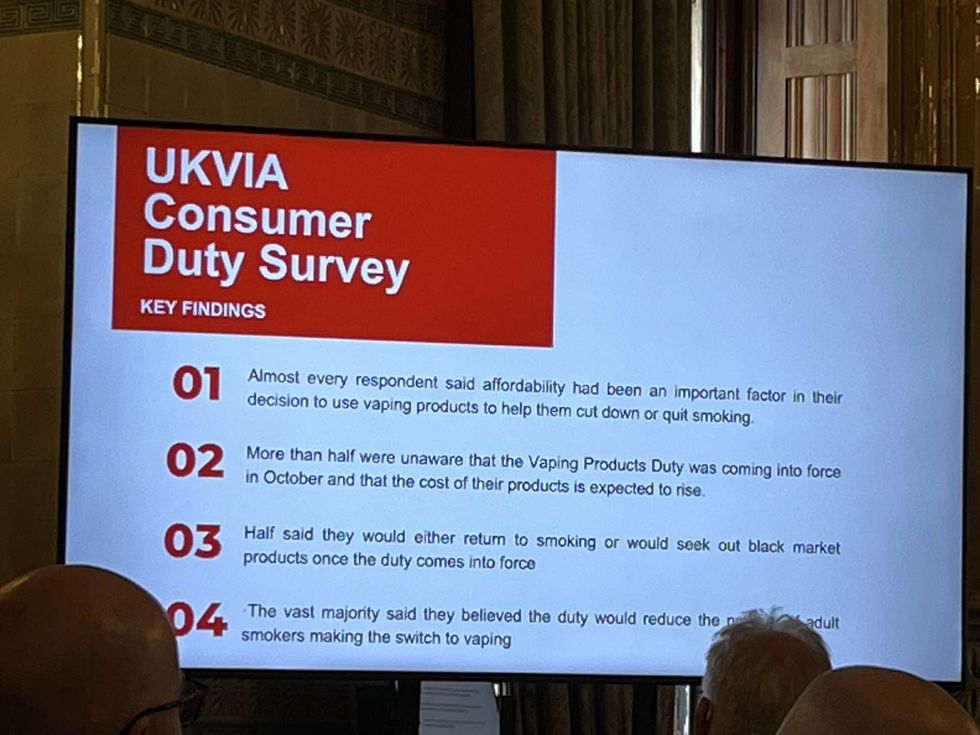
New UKVIA research surveying 3,500 vapers, presented by Tim Phillips of Tamarind Intelligence during the opening panel, found that more than half of respondents said they would either turn to illicit products or return to smoking once the duty applies.
Health psychologist Sairah Salim Sartoni, chief executive of Salim Sartoni Associates, told the panel: “One figure that isn't shown in [the report]… is that 13 per cent of vapers will continue as normal. The rest are going towards the black market or tobacco.” She drew a parallel with the disposables ban, which she said had already pushed around 30 per cent of vapers back to smoking, and cited ASH data showing 54 per cent of UK adults believe vaping is just as harmful as, or more harmful than, smoking.
 A presentation at the UKVIA Forum 2026 Photo: Asian Trader
Sartoni also pointed to nicotine replacement therapy as a comparator, noting that vaping is classed as a clinical tool by the National Institute for Health and Care Excellence, while NRT products attract just 5 per cent tax over the counter and no tax when prescribed. She warned the duty would delay the government's smokefree 2030 ambition “by decades,” and separately noted that funding for the Swap to Stop scheme, which distributed 40 million vape starter kits to smokers via stop smoking services before closing in March, is no longer ring-fenced, leaving services facing difficult choices about how to allocate remaining budgets.
Andrej Kutruff, founder of CEO of Modern Health Group, told the panel it was “a bit pretentious” to frame the incoming regulation solely around youth protection. “Just be open about what you're doing, trying to raise cash… if you don't want to risk public health, give the concessions, maybe tax it like NRT.”
A compliance specialist in the audience added that the combined effect of the duty, licensing, an advertising ban, plain packaging and display restrictions sent a clear message that vaping “is not 95 per cent safer… it's as dangerous as smoking,” predicting the measures would “kill this category off pretty much, and we'll just hand it over to Big Tobacco.”
Modelling questions HMRC's own data
The most detailed challenge to the duty's calculation came from Dan Marchant, co-owner of Vape Club, who presented findings from a Centre for Economics and Business Research (Cebr) impact assessment.
Marchant said Freedom of Information requests revealed HMRC had based the duty rate on an average e-liquid consumption figure of 617ml a year, sourced from an Ipsos access-panel survey that had not screened for genuine vapers among paid respondents. A subsequent UKVIA-backed survey of more than 3,500 self-identified vapers put average consumption at 26ml a week – roughly double the Ipsos-derived figure – which Cebr moderated to 22.5ml a week after weighting against ASH data.
 A presentation at the UKVIA Forum 2026 Photo: Asian Trader
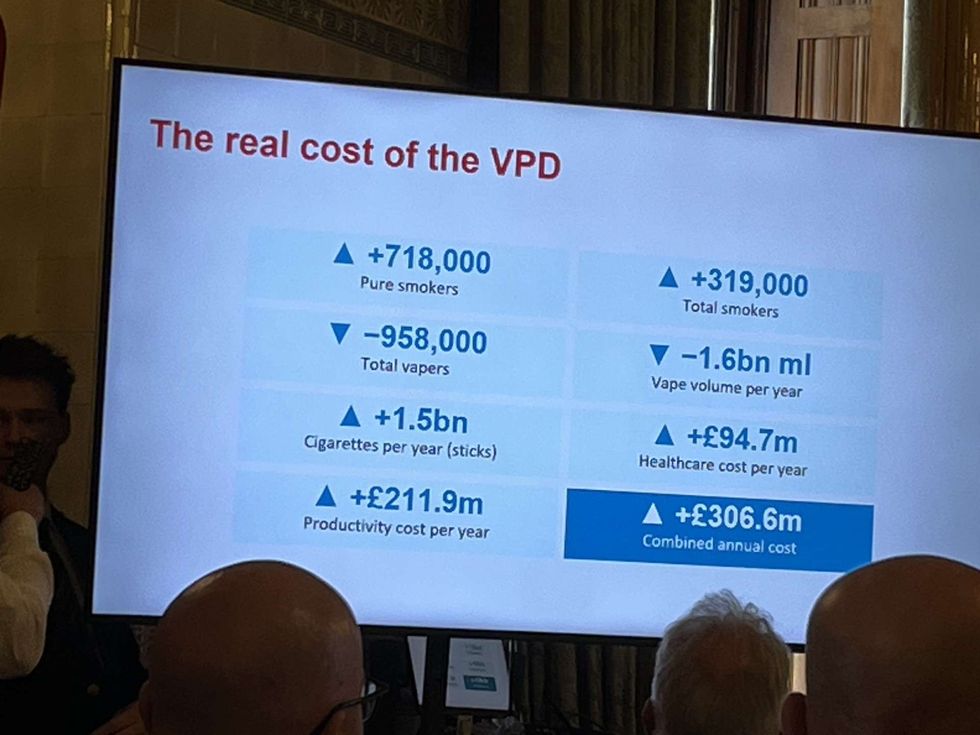
Modelled at the proposed rate, Marchant said, CEBR's analysis pointed to a net increase of more than 700,000 “pure smokers” including dual users transitioning back, comprising a rise of over 300,000 pure smokers and the loss of 400,000 people who were en route to quitting, alongside an additional 1.5 billion cigarettes sold annually and a net cost to the economy exceeding £300 million a year. In addition, the report put the projected loss of vapers at 958,000.
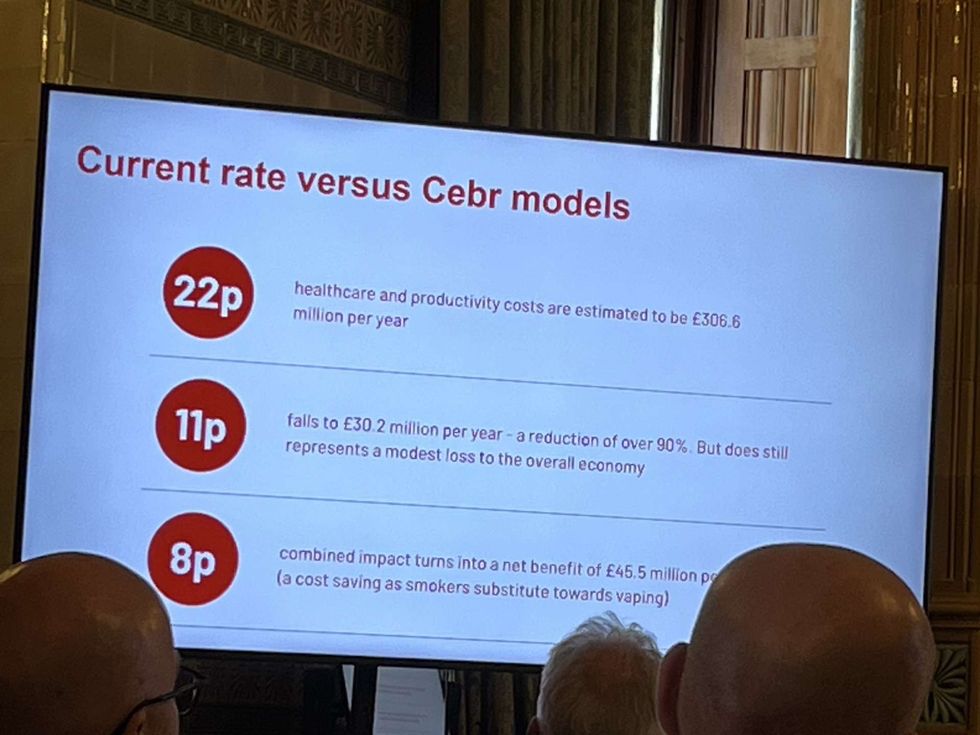
Marchant argued that reducing the rate to 11p per 10ml would cut those additional healthcare and productivity costs by more than 90 per cent, to £30.2 million, while a rate of 8p per 10ml would produce a net benefit of £45.5 million as smokers substituted towards vaping.
“I am under no illusions that we're going to stop the duty,” he said, “but I want HMRC to reconsider the rates because the costs on vapers, on smokers, on the industry, and the economy are just too high to bear and are based on a grossly underestimated figure.”
HMRC: transitional stamps extended, 300 new compliance officers
Responding to member questions in a dedicated session, HMRC's Jacob Holder confirmed the transitional duty stamp arrangement had been extended to the end of the 2026 calendar year to support businesses whose digital systems were not yet ready, while stressing there were “no plans for an extension beyond the 1st of October” for the duty itself.
He said HMRC had recruited 300 new compliance officers and committed £10 million in funding for Border Force activity, with penalties for non-compliance running up to £10,000 and, in some cases, custodial sentences.
Licensing wins broad backing
UKVIA’s new consumer research revealed broad support for the retail licensing scheme provided for under the Tobacco and Vapes Act. Two-thirds of respondents said they either somewhat or strongly supported a licensing scheme, with only 13 per cent opposed, and three-quarters said licensing would make them feel more confident when purchasing vaping products.
Nine in ten said any scheme should not make it harder for adult smokers and vapers to access products.
In a fireside conversation with Marchant, Chris Kelly, founder and chief executive of distributor Phoenix 2 Retail, argued that the scheme’s design mattered more than its scope: “The biggest thing is not what it should include, but what it shouldn't become – a barrier for retailers to operate in the market”.
 A presentation at the UKVIA Forum 2026Photo: Asian Trader
Kelly also made the case for extending licensing further up the supply chain to distributors, not just point of sale, to help prevent illegal products reaching retailers in the first place.
“The retailers are just a product of their environment,” he said, noting that many independent stores were approached by multiple suppliers and often lacked the technical knowledge to distinguish compliant products from illicit ones.
Kelly said reputable distributors already spent considerable time educating retailers about compliance, product testing and certification, but argued that widespread illicit trading had forced legitimate businesses into a constant defensive position.
Licensing, he suggested, should be viewed as a top-down mechanism to improve standards across the supply chain rather than simply another administrative burden for retailers.
Political and environmental angles
Euan Stainbank, Labour MP for Falkirk and chair of the All-Party Parliamentary Group for Responsible Vaping, used his keynote to flag concern over a manifesto commitment by the Scottish government to apply parity between tobacco and vaping product displays, warning it risked undermining the “delta” between how the two categories are perceived at the point of sale.
Stainbank said the APPG would be surveying MPs over the coming 12-week consultation period to build an evidence base ahead of any decisions.
Separately, Lucy Kemp of Biffa raised concerns over lithium-ion battery fire risk linked to disposal of vape devices, citing an estimated 1,200-1,500 fires a year in the waste sector, though another delegate from the floor pushed back, noting vapes account for around 26 per cent of disposed lithium-ion batteries rather than being the sole cause.
Mobilising the “5 million vaper vote”
The Forum also examined how the UK's estimated five million adult vapers might be encouraged to engage politically as the consultation period unfolds.
Charlie Buckley, senior research associate at More in Common, said vapers were harder to mobilise than smokers because many use the product “infrequently and sporadically” rather than as a fixed daily habit, meaning it plays a smaller role in personal identity.
Joe Twyman, co-founder of Deltapoll, argued that raw support for a policy position rarely predicts political behaviour on its own. Drawing on his experience of nine general elections, he said campaigners needed messaging that connects “not just with their heads, but with their hearts as well... so that they feel obliged, or inspired, or exercised enough to then engage.”
Julian Gallie, head of research at Merlin Strategy, said cost of living would likely dominate any vaping-related messaging to the wider public, with the framing that “the government is distracted” from bigger priorities proving more persuasive than health arguments alone.
Buckley, however, warned that framing around youth access remains the most potent driver of public support for restrictions: “When a framing is introduced that children could start vaping… that's where the public loses a lot of their sympathy.”
Euan Stainbank MP, addressing the same theme in his keynote, offered a personal account of switching from smoking to vaping as a teenager, describing the six-month period after taking up flavoured vapes as “night and day” compared with continued smoking.
He said the APPG's central challenge was ensuring that story – of long-term smokers successfully switching – cut through a media environment that, in his view, “always highlight[s] the worst examples.”