





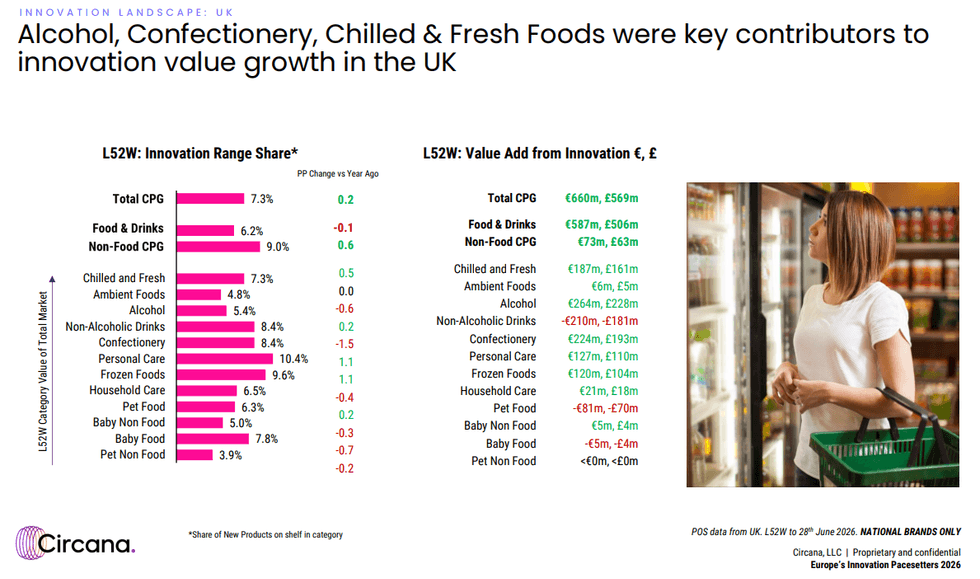
The UK is leading Europe in CPG product innovation, generating £6bn in sales from new product launches and accounting for 21% of all new CPG launches across Europe's six biggest markets (the “EU6”: the UK, Germany, France, Italy, Spain and the Netherlands), according to the latest Europe's Innovation Pacesetters 2026 analysis published by Circana.
Products launched in the past year (the 52 weeks to 28 June 2026) made up 7.3% of active products in the UK, a notably high share compared with the EU6 average of 5.1%.
UK consumers purchased 2.2 billion units of newly launched CPG products in the past year, up by 1 million units (+0.05%) year on year. Across Europe, consumers' appetite for new products is helping to drive significant growth for CPG manufacturers. New CPG launches generated £17.6bn in sales across the EU6, delivering £562mn in incremental value sales, following two years of slowing value contribution from new launches. This came despite 13% fewer launches than a year ago.
This growth is against a backdrop of the continued high cost of living. New and exciting products are a big draw for 'saving-fatigued' shoppers, with 87% of UK shoppers surveyed saying that they noticed new products when shopping in the past month. However, they are reluctant to pay significantly more for them. Circana's data shows that the average price premium of new products over regular items across European CPG fell from 19% in 2025 to 16% in 2026, a drop of 3 percentage points.
One of the industry's most comprehensive innovation reviews, Europe's Innovation Pacesetters analyses 79,000 product launches in 230 categories across France, Germany, Italy, Spain, Netherlands and the UK. It also draws on a survey of 840 shoppers across EMEA. The review maps where innovation is happening, tracks how launches performed in the last 12 months, from 'Superstars' to 'Strugglers', and ranks the leading categories, manufacturers and new brands.
 Circana
“New products continue to delight shoppers who, despite the challenges of balancing household budgets, still want to treat themselves to something new. This desire for discovery and willingness to pay a small premium is something that CPG manufacturers should lean towards in their brand and marketing strategies,” comments Ananda Roy, Senior Vice President and Industry Advisor, Consumer Goods at Circana.
“Innovation is expensive and risky, but with strong incremental sales, it’s a critical driver of growth for both big and small manufacturers. This is particularly true when the new to category innovations tap into new consumer trends, such as GLP-1 friendly meals, functional food and drink ranges, and nutrient-dense products.
“Retailers in Europe are also pushing for innovative new products to help drive footfall. Private labels contribute more to revenue from new products and capture a larger share of value compared to national brands.”
Large brands fight for share of wallet
While bigger CPG manufacturers generally deliver better-performing innovations, scale is no longer a requirement for innovation success, according to Circana. Seven of the top 20 ‘Superstar’ launches in Europe (those generating €1mn+ in sales per SKU in their first year) are by medium and small manufacturers. Mid-sized manufacturers are also increasingly dominant among the highest-value launches, accounting for 15 of the top 50 by launch value, up from 11 a year ago.
Roy added: “Smaller and mid-sized manufacturers are entering this space with faster go-to market strategies that challenge established brands. They are increasingly being supported with accelerator programmes from retailers who want the best mix of new products on shelves to meet consumer demands.”
AI accelerating product innovation
CPG manufacturers are leaning into AI to develop new products, particularly AI-powered flavour discovery, as well as analytics that can determine hit rates for new product launches. Consumers are using AI search and social influencers to discover new products that meet their changing nutritional and occasion needs, such as mid-morning and afternoon energy gaps.
“We’re in an exciting era of CPG product innovation that over the next few years will be driven by human ingenuity and evolving AI capabilities,” commented Roy.
Additional findings:
Country overview:
While the UK leads Europe in innovation value, Germany recorded the strongest unit sales growth, up 342mn units (+17.6%) in the past year, with new products accounting for 6.5% of its active products (its innovation range share). France's lower-priced launches helped drive unit sales but limited value growth.
Despite the dominance of the UK and Germany, Italy is punching above its weight in innovation terms, accounting for 25% of all new CPG launches across the EU6, ahead of the UK's 21%. Italy also had the largest share of new Food & Drink launches in Europe (30%), with the UK and Germany leading on non-food innovation.
Category trends:
- Strong innovation in Chilled & Fresh and Frozen Foods is driving the most incremental value. In the past year, Chilled & Fresh delivered an additional £410mn across Europe and Frozen Foods an extra £293mn.
- Personal Care is the stand-out performer in non-food categories with both value and unit growth, delivering £245mn in incremental value across Europe.
- Confectionery in Europe, traditionally strong in innovation terms, had the highest share of new products on shelf (8%) and delivered £157mn in incremental value over the past year, relying on premium launches to unlock value and unit growth. Confectionery, closely followed by Beverages, also had the highest share of Superstar products (72% by category value).
- Across the six European markets, new products in Chilled & Fresh and Ambient Food categories were priced lower than regular products, on average, while those in Alcohol, Household Care and Personal Care were priced much higher.