




- Shoppers remain cautious ahead of the summer months as seasonal offers increase to 26% of sales
- An earlier-than-usual Easter resulted in a decline in unit sales (-3.6%) and visits (-4.7%) over the four weeks
- Ocado (+14%), Lidl (+8.7% ) and M&S (+6.8%) remain the fastest growing retailers, while Asda (-3.9%) and Co-op (-1.5%) saw a decline in sales
Total Till sales at the UK major supermarkets were down (-0.2 per cent) in the four weeks to 18 April after a surge in sales over the Easter bank holiday (+15.4 per cent) according to new data released today by NielsenIQ (NIQ). Following earlier than usual Easter and Mothering Sunday offers, value sales then declined (-11.8 per cent) during the week ending 18 April compared to Easter week 2025, due to both falling earlier in the calendar year by comparison.
Across all channels, including convenience, shoppers spent a total of £16.9b (-2.1 per cent) in the period with sales across the wider convenience channel particularly weak, with a decline of -2.9 per cent.
Unit sales also declined (-3.6 per cent) over the four-week period partly due to less supermarket visits (-4.7 per cent). Online remained the fastest-growing channel, with sales growth accelerating to +6.1 per cent.
To help demand, retailers also focussed on seasonal offers and across all FMCG, the percentage of sales purchased on promotion accounted for 26 per cent of sales, up from 24 per cent a year ago. This included Easter meal staples such as fresh lamb and fresh salmon as the meat, fish and poultry super category saw the fastest growth with an increase in value sales of three per cent.
Continuing the focus for fresh foods and convenience, there was also more demand for fresh pasta and sauces (unit growth +8.4 per cent), fresh dough and pastry (+5.4 per cent) as well as fresh poultry (+3.1 per cent).
Shoppers focussed on restocking their pantries, with packaged grocery sales up (+3.1 per cent) and units down only slightly (-0.5 per cent). Shoppers also purchased more at supermarkets for entertaining and leisure around the Easter holiday with sales growth for toys (unit sales +5.2 per cent), books (+4.9 per cent) and cooking equipment (+2.9 per cent).
Despite the Easter bank holiday celebrations, beer, wine and spirits sales were down (-5.7 per cent) and units also declined (-7.2 per cent). However ahead of the summer season, with events like Wimbledon and the World Cup, this category is set to see an increase in sales.
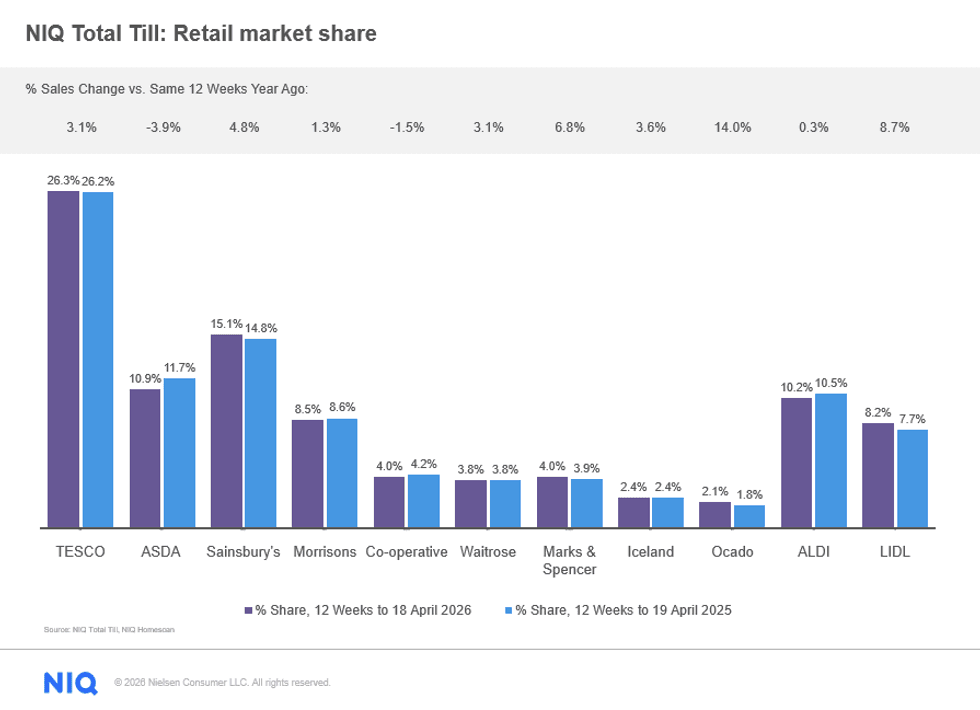 Asda down, Sainsbury's up; Aldi up, Lidl down ...Graphic: NIQ
Over the 12 weeks, Total Till sales increased by +2.6 per cent with Ocado seeing the fastest growth (+14 per cent). Lidl (+8.7 per cent) and M&S (+6.8 per cent) also maintained growth. Tesco (+3.1 per cent) and Sainsbury’s (+4.8 per cent) also gained market share. Morrisons sales continue to improve (+1.3 per cent) while Asda (-3.9 per cent) and Co-op (-1.5 per cent) sales continue to decline.
“Grocery ecommerce share dipped in the last four weeks, compared to earlier in the year, as this reflects shoppers’ preference for visiting stores to buy more fresh items for big seasonal celebration moments such as the Easter bank holiday weekend,” said Mike Watkins, Head of Retailer and Business Insight at NielsenIQ. “However, despite this dip, online momentum remains strong as almost 1 in 3 households (29 per cent) purchased online in the last four weeks, with unit growth up (+2 per cent), and market share increasing to 13.9 per cent of FMCG sales.”
“The increase in promotions reflects the industry’s need to drive demand through offers and promotions to see an uplift in sales and visits. With two thirds of shoppers looking to buy extra for special events at stores 4 this helps drive footfall given that saving money is the key consumer mindset.”
Watkins concluded: “Shoppers will soon be under pressure from higher inflation so it will be important for retailers and brands to keep working together with relevant promotions to encourage shoppers to spend. This will be equally important as we head into another summer of sport - driven by the FIFA World Cup which is only six weeks away. This typically brings a strong feel-good factor among consumers, and with that comes enormous opportunities to capitalise on in the months ahead.”