



Connected surplus food system ZRO officially launches today, giving manufacturers, retailers and brand owners a coordinated way to identify better outcomes for surplus food.
Rather than navigating multiple specialist providers independently, ZRO connects expertise, infrastructure and commercial routes across the food hierarchy, assessing each surplus stream individually to identify the highest-value viable outcome.
ZRO is a new proposition, bringing the full range of surplus food routes together through one connected system for the first time. However, the capability behind it is firmly established. Built on decades of SugaRich Group operational experience, ZRO connects specialist businesses already embedded within food manufacturers’ operations and supply chains. In the UK alone, SugaRich Group operations recovered more than 800,000 tonnes of surplus food in 2025 – giving ZRO proven scale, credibility and capability from the outset.
The approach is already delivering measurable results. In a recent pilot project with a leading UK biscuit manufacturer, applying the ZRO approach increased food-to-food outcomes from zero to more than 30 per cent within ten months, creating more than £156,000 of additional value from 438 tonnes of surplus material.
As businesses face growing pressure to improve resource efficiency, strengthen supply chain resilience and retain more value from food already produced, ZRO provides a practical framework that prioritises keeping food in the human food chain wherever possible.
Until now, businesses have often needed to work with multiple providers to explore different options for surplus food. ZRO connects the expertise, infrastructure and specialist capabilities needed to assess each surplus stream and identify the highest-value viable outcome across five pathways:
- Prevent – using SugaTrak data and insight to identify where surplus arises and help reduce it at source.
- Redistribute – directing suitable surplus food to people through Company Shop Group’s redistribution network.
- Reformulate – turning suitable surplus ingredients into new food products through ZRO Group Ltd.’s food-to-food capability.
- Repurpose – converting suitable former foodstuffs into quality-assured animal feed ingredients through SugaRich and AB Nutrition.
- Recover – using Mobius’ total waste management capability to manage remaining materials responsibly and recover value wherever possible.
The value of ZRO lies not in any single pathway, but in connecting them so that each surplus stream can be directed towards the best viable outcome.
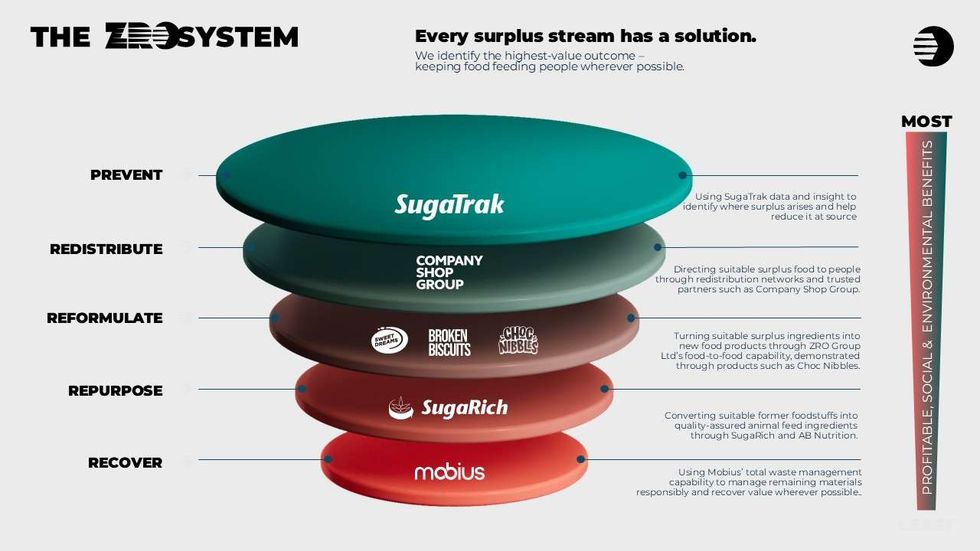 Image: ZRO
From Sweetdreams to ZRO Group Ltd
The launch marks the next stage in the evolution of a Northumberland business with more than 30 years’ experience creating value from surplus confectionery and food ingredients.
Formerly known as confectionery manufacturer Sweetdreams Ltd, the business became ZRO Group Ltd in June 2026, reflecting its broader role as the UK operating business developing and delivering the ZRO system, commercial proposition, partnerships and proof.
In the UK, ZRO draws on specialist capability across the wider SugaRich Group, including SugaRich, Mobius, AB Nutrition and ZRO Group Ltd, alongside trusted external partners where collaboration adds value.
As part of Ravago, this combines the specialist expertise and agility of the SugaRich Group with the scale, infrastructure and international reach of a global organisation operating in more than 60 countries.
ZRO says it bases its work on one simple principle: if something was made to be food, its highest value is to stay food.
“For too long, surplus has been approached as something to manage once the original route to market disappears,” said Matthew Stephenson, Managing Director, ZRO Group Ltd. “We see a much bigger opportunity: to retain as much of the value already created in that food as possible.”