





When DHL Supply Chain set up its dedicated Convenience business unit, it brought together four previously separate operations – the Co-op Wholesale account (formerly Nisa), Morrison's Wholesale (which had just acquired McColl's), the JD Wetherspoon contract, and BP's forecourt business – into a single, specialist arm serving the UK's fastest-growing grocery channel. Three years on, that unit sits behind roughly a fifth of the country's convenience deliveries, running 19 sites and 5,000 colleagues who each week pick and distribute around 1.3 million cages to some 8,000 stores.
It is also, with the research consultancy Retail Economics, co-author of a new piece of industry research: The Availability Effect: Why trust, margin and loyalty start at the shelf edge. Drawing on in-store audits of over 100 stores, a nationally representative survey of 2,000 UK households, and economic modelling against ONS spending data, the report puts a hard number on something every retailer feels intuitively: a gap on the shelf costs more than the value of the item that isn't there. Across UK grocery, the report calculates, stock-outs put £2.1 billion of sales at risk every year, either lost outright or displaced to a competitor, as shoppers switch stores, delay a purchase or trade down.
Nick Archer, DHL's Managing Director for Consumer & Convenience and one of the report's contributors, met up with Asian Trader to talk through the findings, and to explain what a sector already running on famously tight margins can do about it.
Convenience, mapped
Archer is quick to place DHL's role in context. "When it comes to convenience we really are in the shadows, and we're quite happy to stay there, because the real stars are the stores," he says. "Your readership are the absolute unsung heroes; our job is just to enable them to run their businesses."
The scale of that enabling role has grown fast. Convenience is now worth around £55 billion a year, roughly 20 per cent of UK grocery, and DHL's own modelling points to 10 per cent further growth by 2030. Archer traces much of that momentum back to the pandemic. "As cities emptied and we went into lockdown, and later as hybrid working took hold, people's reliance on their local convenience store increased.”
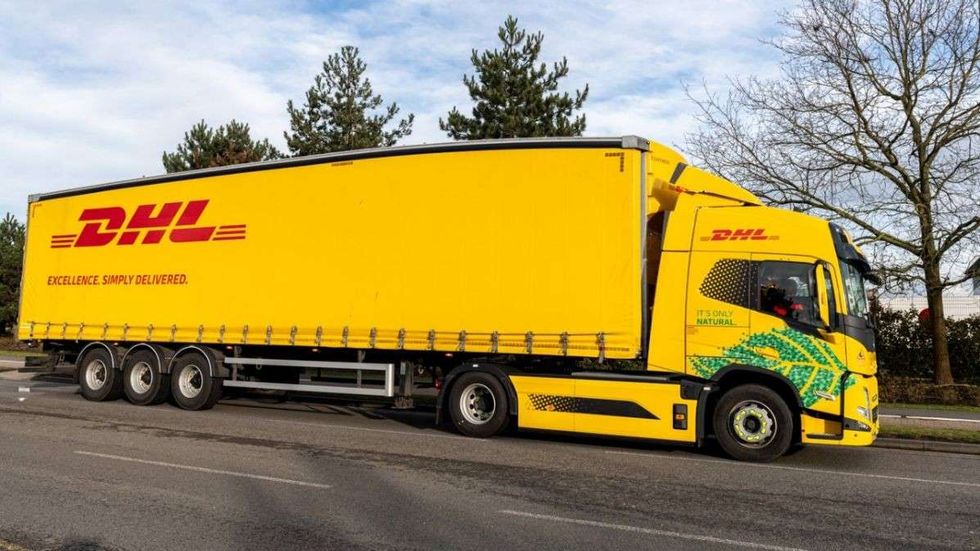 Photo: Handout
There wasn't really an alternative, and it took off from there, he says. "In a way it took us back to the 1960s: people going shopping and meeting their neighbours outside the store. The store became a hub of the community; it gained a soul."
One statistic sticks with him in particular: around 88 per cent of the UK population shop in a convenience store at some point in a given week. "Small basket, high frequency," he says. "Individual basket value has come down, but frequency has gone up. People are going in quite mission-led, buying exactly what they need for that evening."
That shift in mission is precisely why availability has become so commercially sensitive. If a big weekly shop is missing one item out of forty, a shopper can usually absorb it. If a single, mission-led convenience trip – tonight's dinner, a last-minute gift, a round of milk before the school run, perhaps – comes up empty, there is no slack to absorb the disappointment. "There's no room for error in a convenience supply chain, because there's literally no room," Archer says. "No storage space in the store, and no slack in a store manager's day."
Numbers behind the headlines
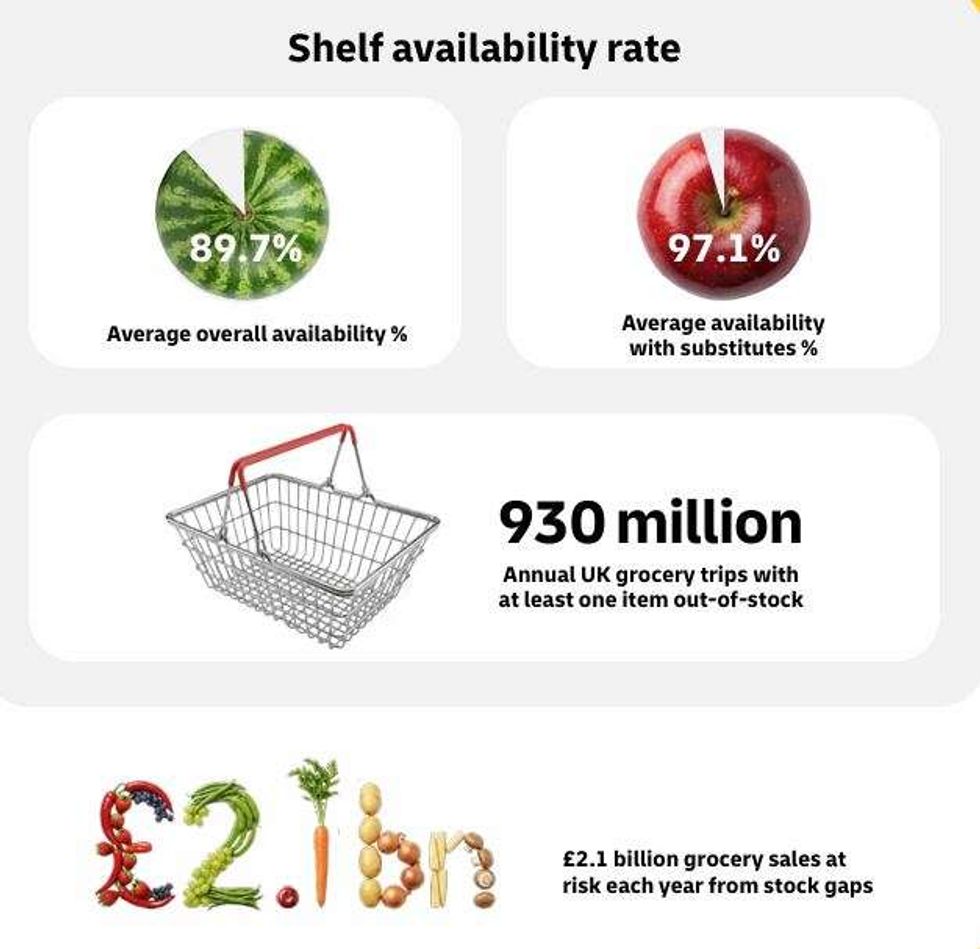
The Availability Effect puts real weight behind that instinct. DHL and Retail Economics' national audit found average on-shelf availability of 89.7 per cent, rising to 97.1 per cent once comparable substitutes are counted – a strong performance by international standards, but one that still leaves real gaps at scale. Across the study's 100-plus store audits, 82 per cent of stores were missing at least one of the 40 high-frequency items in a typical weekly shop, and 64 per cent were missing two or more.
Around one in five grocery trips (roughly 930 million visits a year) now involves at least one out-of-stock item. The report models the annual cost of that at £2.1 billion in displaced or lost sales, set against a £180 billion in-store grocery market.
 Source: Retail Economics, DHL Supply Chain
“Something like 60 per cent of under-45s will shop somewhere else if a product is regularly out of stock. That's why on-shelf availability is probably the number one priority for me.”
Archer's figure lines up closely with the survey data: 44 per cent of shoppers overall say they have switched or added a supermarket in the past year because of availability issues, rising to almost two-thirds of under-45s. It isn't simply about price sensitivity, he argues, and the report states that one in three consumers now rate product availability as more important than price when deciding where to shop, a share that climbs to 63 per cent among the most affluent households. "If shoppers can't buy the deal, the deal doesn't matter," as the report puts it.
Four kinds of shopper
Perhaps the report's most useful tool for retailers is its shopper segmentation, built with Retail Economics from store-visit interviews and demographic modelling: four tolerance-based personas the report calls the Defectors, the Flexers, the Pragmatists and the Faithfuls.
I asked Nick how he arrived at them.
“That work was done with Retail Economics, Richard Lim's firm,” he answered. “We had the insight and the relationship with the grocers, so we told them what we were doing, went out and made store visits, interviewed shoppers, and went into real depth. Richard and his team built the categories from the demographics and the interviews. You could probably place yourself in more than one of them, depending on the day. I certainly can.”
 Source: Retail Economics, DHL Supply Chain
The commercial stakes vary sharply between the four. Pragmatists, who are defined as “Practical, value-conscious shoppers who accept the occasional gap if pricing and experience stay consistent” could be said to function as the control group. They are steady and slow to anger. But the “Defectors” are time-pressed family shoppers, around 40 per cent of the market, and are low-tolerance but high-spend. The report finds 78 per cent have switched stores in the past year over stock gaps, against a 44 per cent national average, and alone account for 52 per cent of all sales at risk from poor availability.
At the other end, the “Faithfuls”, who are older, routine-led shoppers making up 30 per cent of the market, are far more forgiving, with only five per cent having switched stores; but they still represent £420m of sales at risk simply through reduced spend and quiet disengagement. Together, the low-tolerance Defectors and Flexers (“Younger, agile shoppers who flex easily between retailers and channels”) make up six in ten shoppers but drive around three-quarters of all sales at risk from stock gaps.
 Source: Retail Economics, DHL Supply Chain
Archer describes the emotional charge behind these numbers vividly. "At the extreme end, if you're short on time, or it's a date night, or someone's birthday, and you need something on the way home, it simply has to be there," he says. "That's shopping that used to happen in a supermarket or a big store, and now happens in a convenience store with half an hour's notice." Roughly half of shoppers surveyed said repeated stock-outs might make them stop returning to a store altogether. "One crack, and you're out," as Nick puts it.
The report's own modelling (using a Van Westendorp-style tolerance analysis, if you’re interested), identifies three behavioural thresholds that echo Archer's account almost exactly: shoppers find one to two missing items merely an "acceptable" irritation; three to four items tips them into visible "frustration"; and five or more items marks a "point of no return", where patience collapses and loyalty is genuinely at risk. Around 30 per cent of stores audited, which were disproportionately smaller formats (because availability is more tremulous the smaller the footprint), fell into that high-risk zone.
Convenience's particular exposure
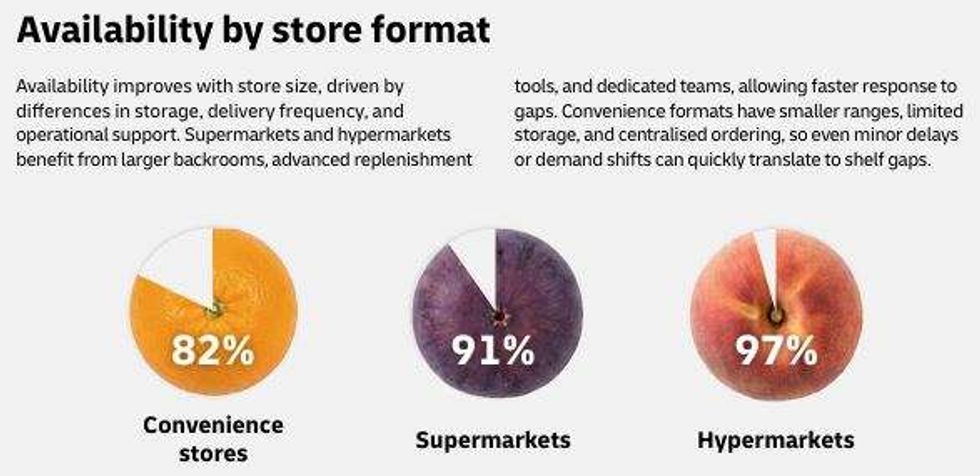
This is where the report's findings bite hardest for the channel. On-shelf availability in convenience stores audited for the report sat in the low-to-mid-80 per cent range, against supermarkets and hypermarkets operating well into the 90s (91 per cent and 97 per cent respectively). Convenience stores represent around a fifth of UK grocery sales, but account for almost half of all displaced spend caused by stock gaps — £964m of the £2.1bn total, the report found. Two out of three consumers say they notice the difference, agreeing that stock availability is lower in convenience stores than in larger supermarkets.
Archer's explanation matches the report's own diagnosis of "demand-side" and "operational" pressures unique to small formats: limited backroom space, smaller product ranges that make any gap more visible, rapid stock turnover, and lean staffing that leaves little buffer when a delivery slips. "They haven't got big stockrooms," he says simply.
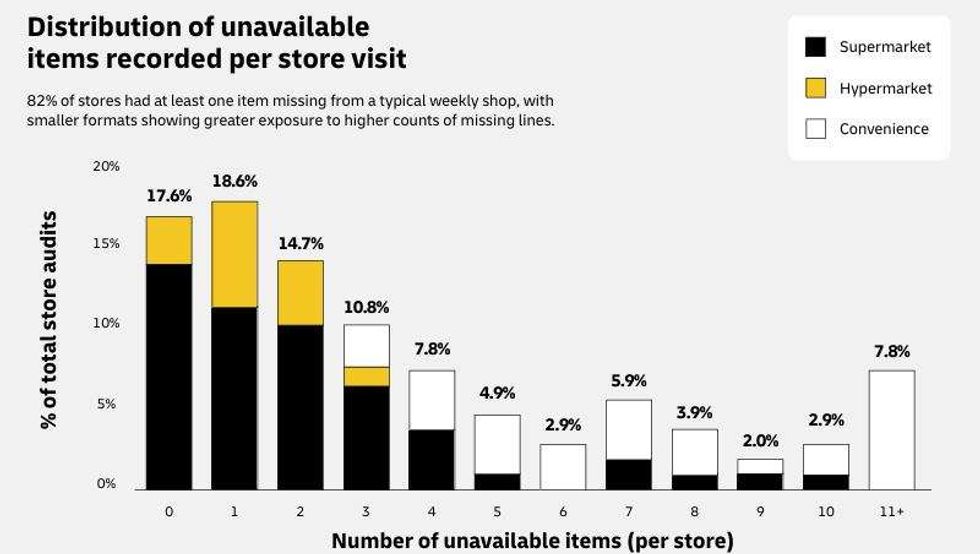 Source: Retail Economics, DHL Supply Chain
It's a gap DHL is trying to close from the supply-chain side rather than the shop floor: is DHL is actually leaving the warehouse with deliveries for individual stores?
“Correct," Archer says. "We've got 19 sites across the country and 5,000 colleagues working shifts, seven days a week, picking store orders into cages, and then distributing them to the store. It’s what we call the 'final mile': tail-lift down, driver unloads, wheels it into the store." Last week alone, he says, DHL made around 20,000 deliveries for its clients.
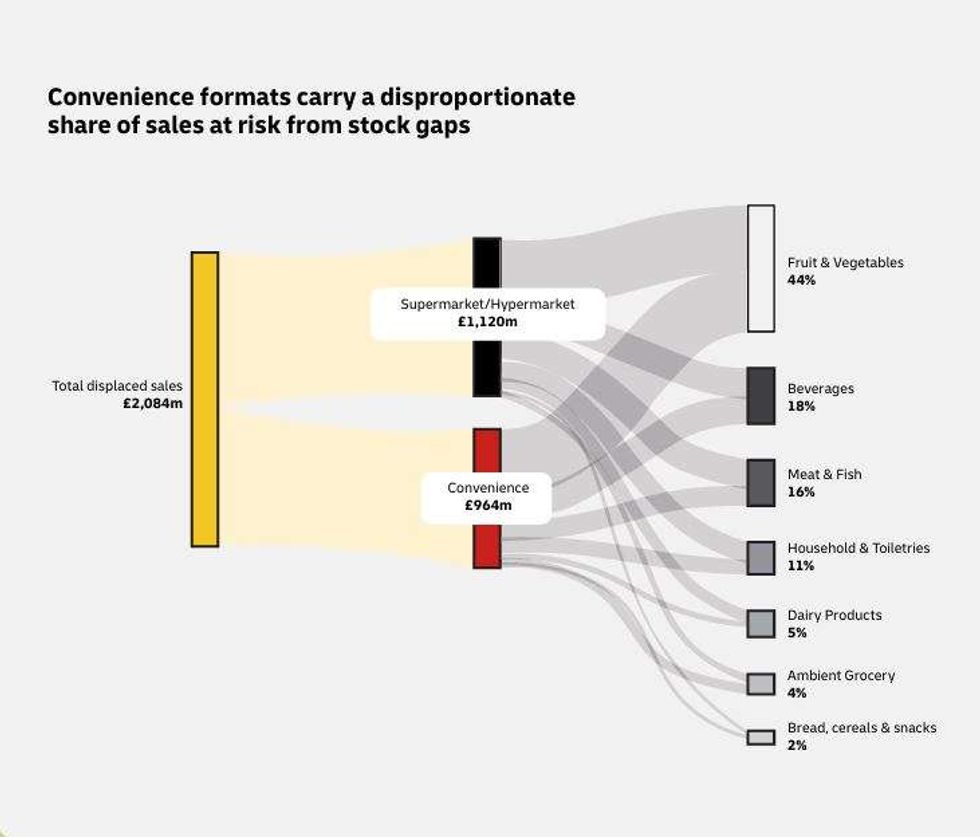 Source: Retail Economics, DHL Supply Chain
Peak trading this year stretched that model to its limit. A normal six-week summer peak became sixteen weeks across five separate heatwaves, explains Nick, with volumes up around 15 per cent in a typical peak and a further 20 per cent on top of that during the heatwaves themselves. He says demand shifted from lighter items like eggs and avocados towards bulky, heavy lines such as soft drinks and beer. DHL ran roughly a fifth more vehicles and a fifth more drivers to cope.
"One of our larger grocery clients ... told me last week that our NPS score [the customer loyalty metric that measures how likely a customer is to recommend a company's product or service to others] was the highest it's ever been, at the end of the busiest, highest-volume, hardest peak we've ever delivered," Archer says, crediting DHL's ability to bring in support and assets from elsewhere in its 35,000-strong UK workforce.
Forecasting forward, not backward
Much of DHL's recent investment, Archer says, has gone into shifting demand planning from a reactive to a predictive discipline. "Historically you'd look at what sold last week and replicate it, then wonder why you had stock-outs," he says. "Now we're looking forward, using algorithms built on geography, weather and local nuance as well as sales history." Diwali is his example: no single national spike, but sharp, localised uplift in specific communities that DHL now resources for directly, in fresh food especially.
On the technology front, DHL has invested in an agentic AI tool it calls Happy Robot, which lets store managers call a dedicated line, quote their store ID, and ask for a delivery's ETA (linked to vehicle telematics), whether substitutes are on the load, or which cage a particular product is in, made possible by "scan tower" technology that logs every cage before it leaves the warehouse. Real-time "control towers" of planners now also replan delivery routes dynamically through the day, rather than running fixed routes. It’s a response to "cubing out", where a vehicle built for 16 cages is asked to carry 18, and two get left behind, Archer explains. The report's regional availability findings, he adds, revealed where DHL needed to add resources most urgently.
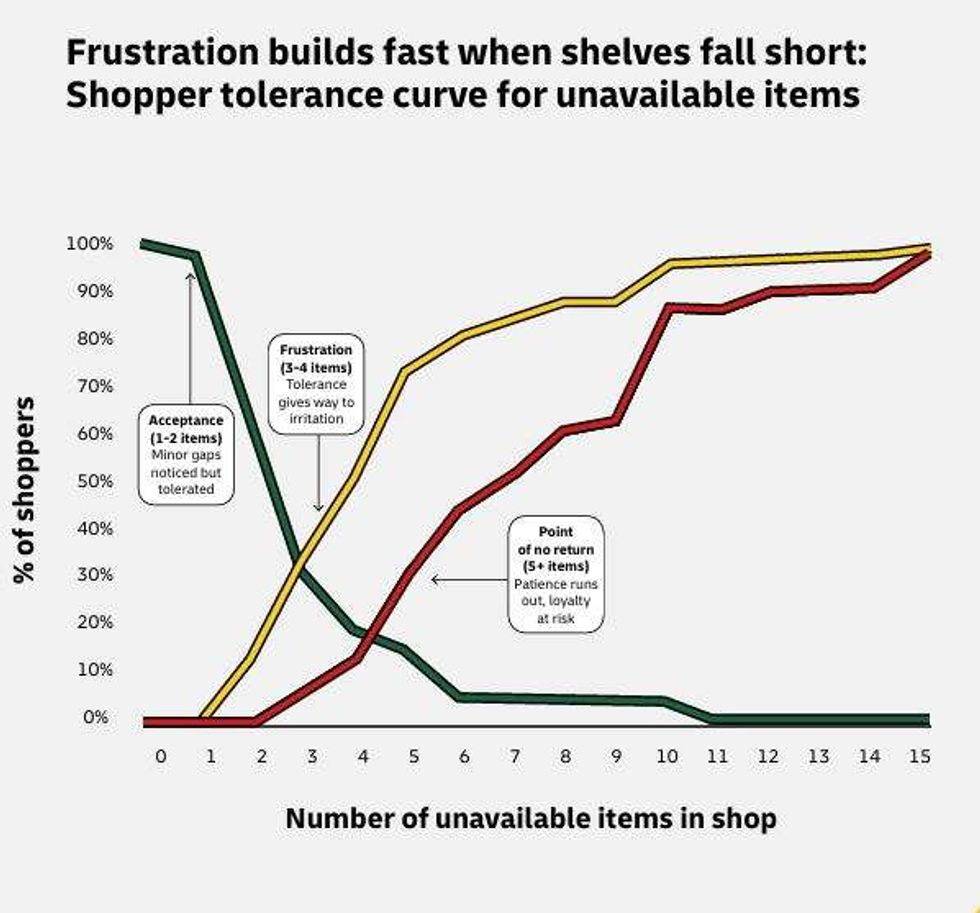 Source: Retail Economics, DHL Supply Chain
Underpinning all of it, for Archer, is a simple proposition: availability is not a back-office metric but a public expression of trust and one that increasingly shapes which fascia or symbol group an independent retailer chooses to join. "When an independent chooses a fascia, they're really choosing a supply chain," he points out, "and I'd argue reliability and availability should be one of the top reasons for that choice. There's no point having a cheap price or a great own-label range if the goods aren't actually on the shelf."
It's a lesson the sector has learned the hard way. Asian Trader put it to Archer that during the tightest points of lockdown, some wholesalers appeared to prioritise larger multiple-retail accounts over convenience – an impression that has not entirely faded. "Completely understand that," Archer says. "The range has changed too. It used to be that if something was missing, you could just nip to the cash and carry yourself and sort it. Now the range is much broader and much fresher, and stores are relying on us to be there every single day. We recognise that availability drives their footfall and their growth, and we take that responsibility seriously."
For Archer, the underlying message of the report is straightforward. Convenience retail has never had it so good in terms of consumer attention and investment, but the margin for error has shrunk in step. "Availability has become a quiet but powerful differentiator," as the report concludes: "a margin of just one or two percentage points in on-shelf performance can make a significant difference to trading results and customer loyalty."
The Availability Effect: key numbers
Figures below are drawn from The Availability Effect: Why trust, margin and loyalty start at the shelf edge (DHL Supply Chain / Retail Economics, 2026), based on audits of 100+ stores and a survey of 2,000 UK households.
89.7 per cent / 97.1 per cent | Average UK on-shelf availability, rising to 97.1 per cent with acceptable substitutes |
£2.1bn | Grocery sales displaced or lost each year due to stock gaps, against a £180bn in-store market |
1 in 5 / 930m | UK grocery trips involving at least one out-of-stock item, ~930 million visits a year |
82 per cent / 64 per cent | Stores audited missing at least one item / two or more items from a typical weekly shop |
1 in 3 | Consumers who now rate availability as more important than price when choosing where to shop |
82 per cent (convenience) | Convenience-store on-shelf availability sits in the low-to-mid-80s, vs 91 per cent (supermarkets) and 97 per cent (hypermarkets) |
~½ of displaced spend | Convenience stores are ~20 per cent of grocery sales but ~46 per cent (£964m of £2,084m) of all displaced spend |
44 per cent / 66 per cent | Consumers who switched/added a supermarket due to availability in the past year, rising to two-thirds among under-45s |
5+ items | The 'point of no return' threshold: once five or more items are missing, shopper patience collapses |