





Dear readers and my friends from the UK,
I sold our One Stop Mount Nod store in Coventry and moved to Dubai last year yet retail still refuses to leave me.
I made the move to begin a new career in real estate, but retail continues to remain in my blood.
Here in Dubai, I still walk into convenience stores and supermarkets with the same instincts, watching customer flow, scanning ranges, and asking myself, what is really earning its space?
Dubai's convenience sector is often described as futuristic, but the reality is that it is far more practical.
I keep observing and absorbing and mentally making notes of things on what British convenience retailers back home can and should learn from their Dubai counterparts.
Justifying every square foot
Many independent stores here operate in footprints of less than 400 sq ft. Rents are high, labour is expensive, and competition is relentless.
As a result of high costs and limited space, every square foot in Dubai has to justify itself. And this single fact shapes almost every retail decision.
Space is not wasted on visual theatre. Layouts are clear and shoppable. Shelves are higher, displays are unfussy, and fixtures are chosen to maximise selling space rather than to impress passing trade.
The focus is not on how the store photographs for social media, but on how efficiently a customer can get in, find what they need, and get out.
In the UK, there was a period where many independents, encouraged by refits and supplier investment, focused heavily on creating attractive stores, better lighting, open space and eye-catching displays.
There was genuine value in that. But with operating costs rising sharply on both sides, Dubai offers a timely reminder that retail fundamentals tend to outlast trends. Clear layouts, tight range, and strong availability matter more than ever.
Service as sales driver
With limited space, service becomes a differentiator. Dubai’s independent retailers lean heavily on staff interaction to replace surplus range. Tastings are common.
Fresh food is prepared to order. Staff make recommendations based on time of day and customer need.
This is not hospitality for show-off or theatre but it is purely commercial.
When you cannot stock everything, such conversations become part of the fixture. UK independents already understand service, but Dubai shows how powerful it becomes when it is treated as a sales driver rather than just a matter of good manners.
Leveraging WhatsApp
One of the most effective tools used by retailers here is also one of the simplest. WhatsApp remains central to how many stores trade.
It is used daily to promote products, share offers, confirm availability and take delivery orders.
Many UK retailers adopted WhatsApp during Covid, but many gradually stepped away from it once trading normalised.
In Dubai, it never stopped. In dense residential areas, customers value speed and familiarity. They want a quick reply from a store they trust, not another app to download or navigate.
The lesson is not about technology. It is about owning a direct line to the customer.
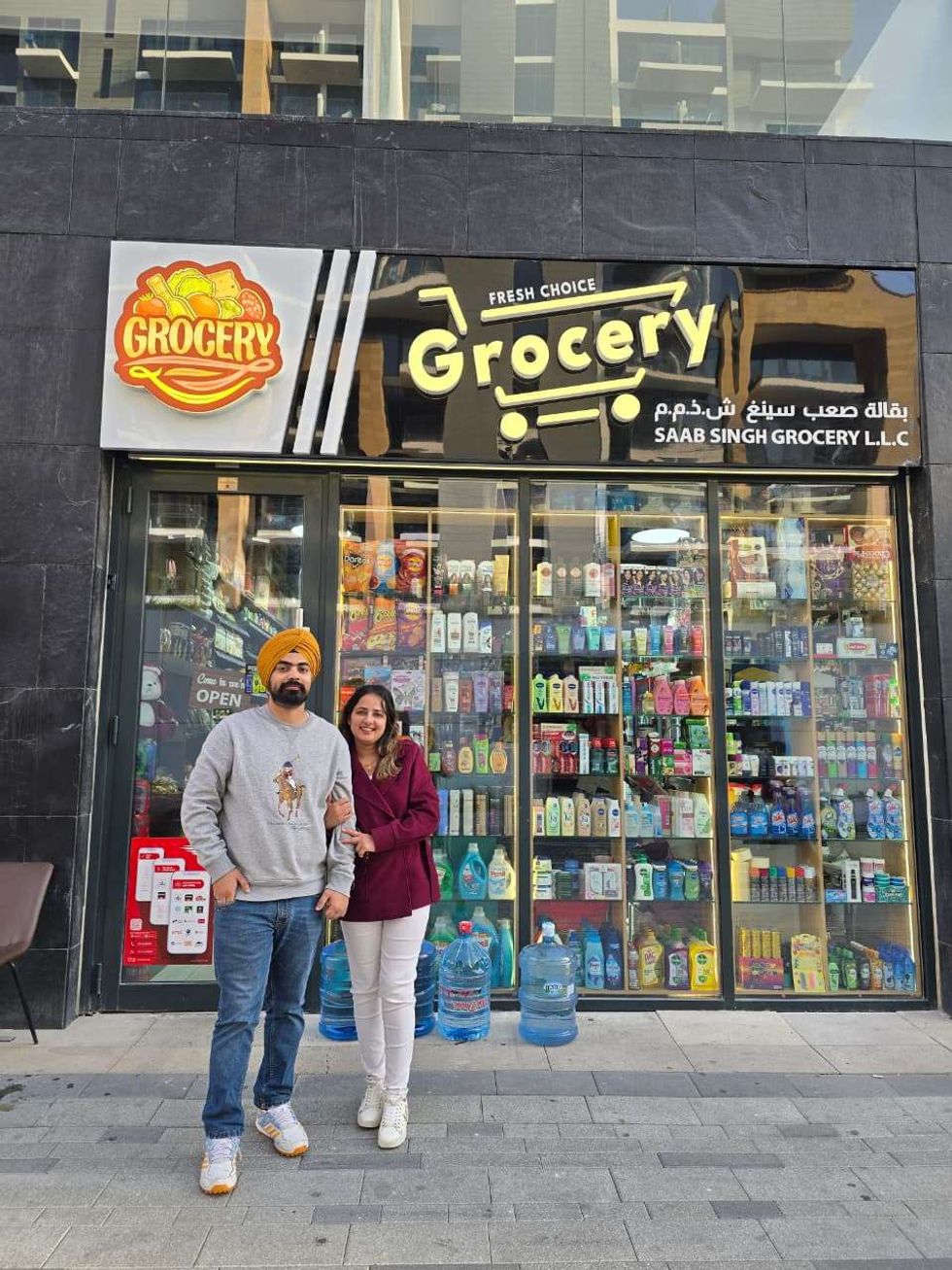 Singh Saab and his wife Parminder Kaur, the first Sikh independent c-store retailers in DubaiImagr given by Aman Uppal
Delivery built into the model
Delivery is fully embedded into the store model. Even the smallest stores are designed to serve walk-in customers and rapid delivery platforms at the same time. This forces discipline.
Ranges are built around what sells quickly, what travels well and what repeats day after day.
Products that do not justify their space are removed without sentiment. For UK retailers, the takeaway is not simply to do more delivery, but to range with delivery behaviour in mind, even if it still represents a smaller share of sales.
Focus on health products
Another noticeable difference is how health-led products are treated. High-protein snacks, functional drinks, collagen supplements, low-sugar and free-from options are not positioned as trends or trial ranges.
They are part of the core offer.
Protein is not a trend here. Collagen is not niche. Functional nutrition is treated as everyday consumption. UK independents are already stocking these products, but Dubai shows the impact of committing fully.
What I see here in this section is clearer merchandising, stronger repeat purchasing and less hesitation from shoppers who already expect to see these lines.
Fresh Food in Small Spaces
Fresh food plays a central role, regardless of store size. Small counters produce sandwiches, wraps and hot items with limited menus and clear production windows.
It works because it is disciplined. Fast turnover, defined peak times and close control of waste make fresh food one of the most productive uses of space in the entire store.
Services and Collaboration
Basic services remain an important part of the offer. Printing, scanning, SIM cards, top-ups, bill payments, parcel handling and even passport pictures are common services offered from even small-format convenience stores.
These services do not always deliver high margins, but they create frequency and trust. Customers return because the store solves everyday problems.
Retail sales follow naturally.
Collaboration is also more visible than many might expect. Local stores regularly partner with independent food producers, coffee brands and small suppliers.
These collaborations refresh the offer without adding operational complexity. The store becomes a platform, not just a shelf for products.
Final Thoughts
Dubai is not a blueprint for UK convenience retail. The demographics, regulations and economics are different, and no market can ever copy another successfully in full. But there is value in observation.
Ultimately, no one understands their customers better than a true retailer.
The opportunity is not to replicate what works elsewhere, but to take what resonates, adapt it locally, and apply it with confidence.
Retail may no longer be my profession, but it remains my passion. And stepping outside the UK has reinforced one simple truth. Independent retail thrives when it stays close to its customers and remains ruthless about how it uses its space.
Before signing off, I would be remiss not to mention the current geopolitical tensions affecting the region. Living here in Dubai, it has been inspiring to see how local communities, particularly independent retailers, have responded.
Despite uncertainty, stores have remained open responsibly, staff have reassured customers, and many retailers have even offered their premises as safe places for residents in nearby apartment buildings seeking reassurance or assistance.
It reminded me strongly of how UK independent retailers stepped up during Covid, putting community and service ahead of everything else.
Different circumstances, yet the same spirit that defines great shopkeepers everywhere. The shop may change, the street may change but the instinct to serve your community should never cease.
Sending warm wishes from Dubai,
Aman Uppal
(A retailer who never stopped thinking like one)