



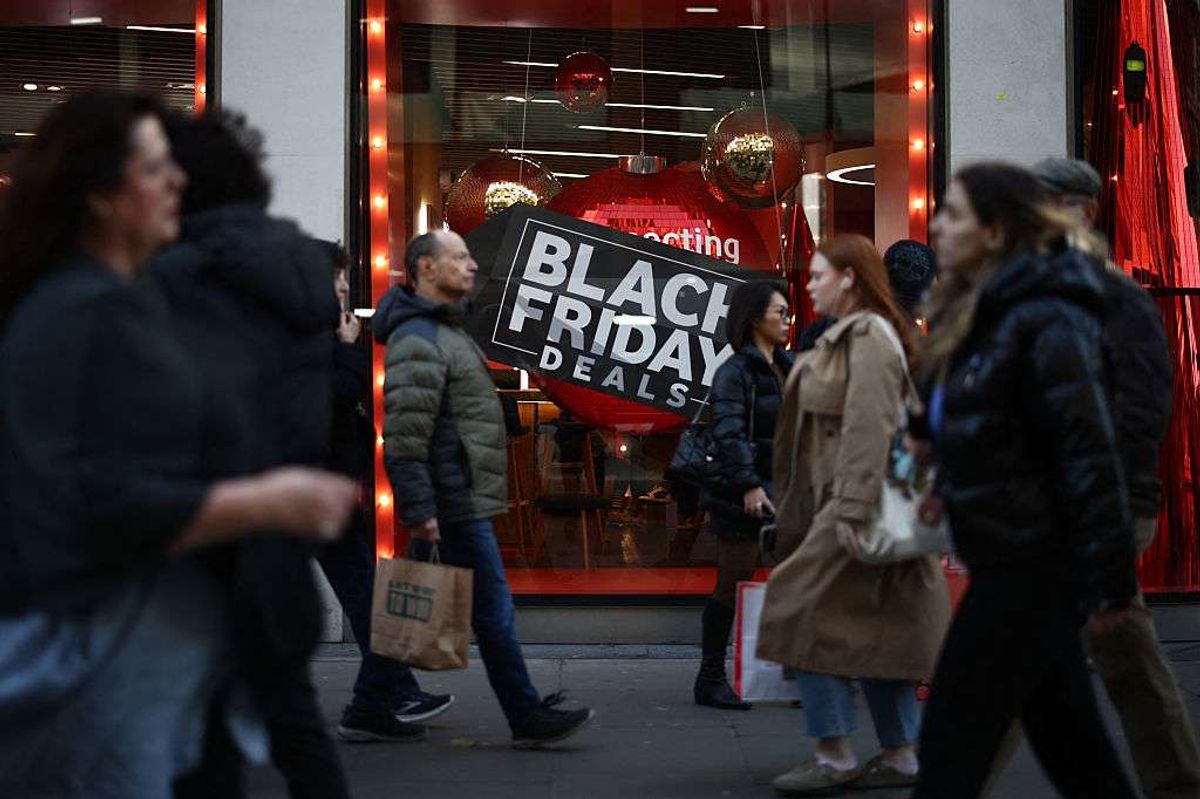

Retail sales slipped again in November as budget uncertainty, wet weather and cautious consumers blunted the impact of Black Friday, according to the latest figures.
Data from the Office for National Statistics (ONS) shows retail sales volumes fell by 0.1 per cent month-on-month in November, following a sharper 0.9 per cent decline in October. The drop was driven by a 2.9 per cent fall in non-store retailing and a 0.5 per cent decline in food sales. Household goods rose by 1.8 per cent and clothing sales increased by 1.7 per cent, offering some pockets of resilience.
“A second consecutive month of decline in retail sales will be a big disappointment for retailers, particularly with Black Friday and early Christmas shopping captured in these figures,” Oliver Vernon-Harcourt, head of retail at Deloitte, said.
Economists polled by Reuters had expected sales volumes to rise by 0.4 per cent in month-on-month terms last month.
“This year November's Black Friday discounts did not boost sales as much as in some recent years,” Office for National Statistics senior statistician Hannah Finselbach said.
“Meanwhile, our separate household survey showed that although some people said they were planning to do more shopping this Black Friday than last, almost twice as many said they were planning to do less.”
Nicholas Found, head of commercial content at Retail Economics, said November highlighted “just how fragile retail remains”, despite Black Friday being the defining event of the month.
“While Black Friday was the month’s defining event, its impact was dampened by heightened uncertainty ahead of the Budget, with shoppers tactical and value-focused,” he said. Research by Retail Economics and MRI Software found three-quarters of consumers planned to shop Black Friday, but mainly to pull forward Christmas spending rather than spend more overall.
Growth was concentrated in fashion, beauty and home, Found added, and was “narrow and selective”, shaped by tight household budgets rather than renewed confidence.
Late uplift
While inflation eased in November as promotions delivered value, he warned that retailers are increasingly competing for the same spend. “Wins increasingly come at a competitor’s expense,” he said, adding that returns volumes in the run-up to Christmas will be a key test of whether heavy discounting converts into profitable growth.
In the three months to November, sales rose but the 0.6 per cent rise was the weakest reading since the three months to August.
Supermarket sales volumes fell for a fourth consecutive month and jewellers reported lower demand for gold items as prices of the precious metal stabilised after their surge.
The November data was collected between November 2 and 29. Chancellor Rachel Reeves announced her budget on November 26.
Jacqui Baker, head of retail at RSM UK, said speculation around tax rises and “the wettest weather seen this year” dampened sales, compounding a bleak start to the Golden Quarter. “Not even Black Friday deals could entice shoppers to splurge ahead of Christmas, with the biggest fall in online,” she said.
However, Baker pointed to a potential late uplift, noting that consumer confidence has ticked up in December following what she described as a more benign Budget than feared. “With no major shocks, confidence should start to improve just in time to turn around fortunes in the Golden Quarter,” she said, as shoppers make last-minute trips to the high street and local stores.
Looking ahead to 2026, Baker warned of ongoing headwinds, including low confidence, rising employment costs as the national minimum wage increases, and business rates reform that could disproportionately affect larger operators and online businesses. She said retailers would need to sharpen their propositions to tempt cautious consumers to spend.
Thomas Pugh, chief economist at RSM UK, said the November dip was mainly driven by weaker food sales, while volumes elsewhere rose by 1.0 per cent month-on-month. “That is a good sign that all was not lost in the pre-budget chaos,” he said, although he noted that heavy discounting pushed retail goods prices down by 0.2 per cent on the month.
Pugh added that while improving confidence could support spending, the outlook for next year remains challenging, with real household incomes expected to grow by just 0.5 per cent amid a weakening labour market and still-elevated inflation.
Meanwhile, Jonathan Moyes, head of investment research at Wealth Club, described the data as “another grim reading” for the UK economy, warning that higher taxes risk further undermining consumer confidence, despite recent interest rate cuts by the Bank of England.
“Clearly consumers are hurting and higher taxes will only make matters worse, potentially hampering economic growth and risking an economic doom loop,” he said.